
The Mechanics Behind Each One
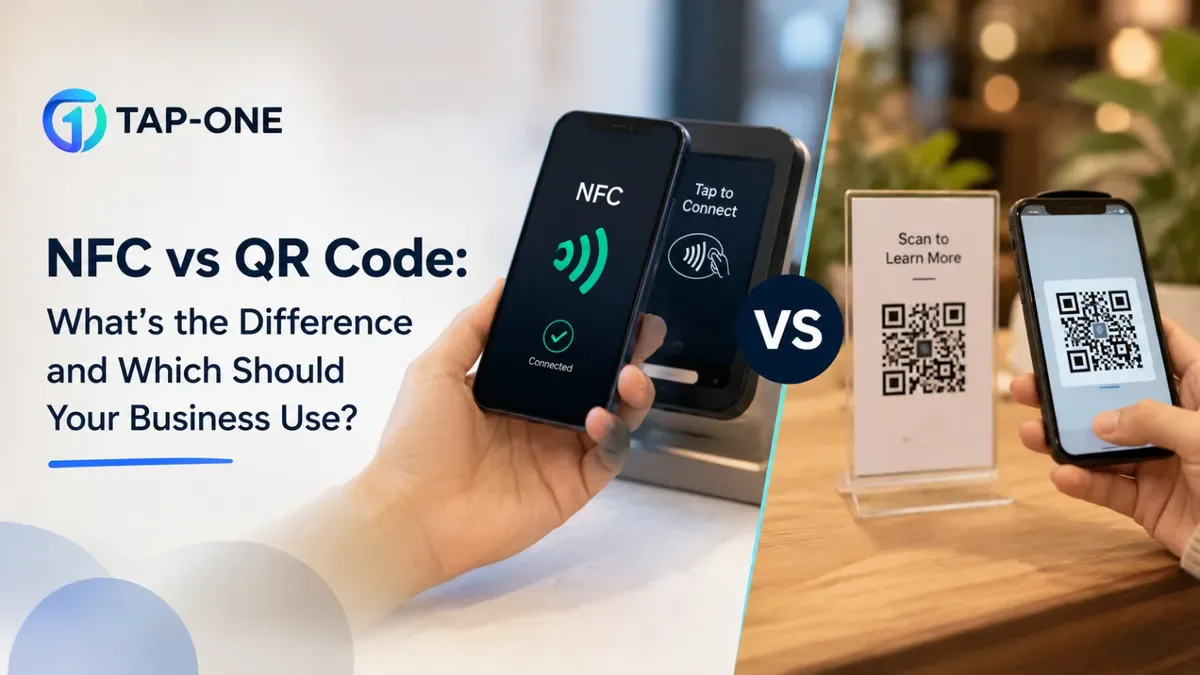
A QR code is a printed pattern encoding a link. The customer opens their camera, points it at the code, taps the notification that pops up, and lands on whatever page it’s pointing to, usually a menu, a review form, or a website.
NFC skips that whole sequence. A small chip sits inside a card, sticker, or stand, and when a phone touches it, the phone reads the chip and opens the link directly to something like a Google Business Profile (opens in new tab) review page. No camera step, no notification tap, on most Android and iPhone models made in the last several years.
Side-by-Side Comparison
| Factor | QR Code | NFC |
|---|---|---|
| Setup cost per unit | Low, printed sticker | Moderate, embedded chip hardware |
| Speed of interaction | Open camera, aim, scan, tap | One tap, done |
| Device compatibility | Any phone with a camera | Needs an NFC-enabled phone (most since 2018–19) |
| Perceived feel | Familiar, functional | Premium, modern |
| Best for | High-volume, low-cost placement | A small number of premium touchpoints |
Where NFC Pulls Ahead
- It’s genuinely faster, one tap versus open-camera-aim-scan-tap.
- It reads as more premium, usually because it’s built into a metal or acrylic stand, a business card, or a table tag.
- It still works even when a customer's camera app is slow to open or their default scanner isn't set up right.
- Harder to visually ignore than a printed code that can blend into busy signage.
Where QR Still Wins
- Works on any smartphone, no NFC chip needed on the customer’s end, though nearly every phone sold in the last several years has one anyway.
- Much cheaper to produce and reproduce; a printed sticker against an embedded chip isn't close.
- Already familiar to most Indian customers thanks to UPI alone, no explanation needed.
- Easy to scatter across more surfaces, table tents, packaging, receipts, posters, without adding hardware cost each time.
How Restaurants Use Each One Differently
A restaurant almost always needs QR at scale, one code per table for the digital menu, and that’s the higher-volume use case where cost matters most.
NFC shows up better at the billing counter for a review request, since it’s a single touchpoint per visit rather than something needed at every table.
How Salons and Clinics Tend to Use Each One
A salon or clinic has fewer touchpoints overall, which makes NFC more affordable relative to the volume. A single NFC stand at reception, used for reviews or a digital business card handoff, often covers the whole need.
QR still has a place for a printed price list or service menu near the waiting area.
So Which Should You Actually Use?
For most businesses the real answer is both, aimed at different jobs. QR handles high-volume, low-cost placement: every table, every receipt, every poster. NFC earns its cost at a handful of premium touchpoints, the reception desk, the billing counter, a card handed to a customer directly, somewhere the tap adds a small moment of polish.
A combined QR and NFC setup lets one link, whether it points to a menu, a booking page, or a review form, run across both formats without maintaining two separate systems behind the scenes.