
Why Google Reviews Decide Who Shows Up First
Google's local algorithm runs on three things: how close you are to the person searching, how relevant your listing is to what they typed, and how much Google trusts you. That third factor, prominence, leans on reviews harder than it used to, and the gap between businesses that manage this well and businesses that don't has only widened.
A place with twelve five-star reviews will lose to a competitor sitting at 4.6 stars across three hundred reviews. I've watched this exact matchup play out on the same street, same category, same price point, more times than I can count. Volume and recency beat a perfect but thin rating almost every time.
Customers feel this too, even without naming the algorithm behind it. BrightLocal (opens in new tab)'s research puts the cutoff around three stars; below that, most people won't click through to see what you're about. It's a filter that happens before your phone ever rings, which means by the time you notice fewer calls coming in, you're already behind.
The Direct Link Between Review Volume and Local Rankings
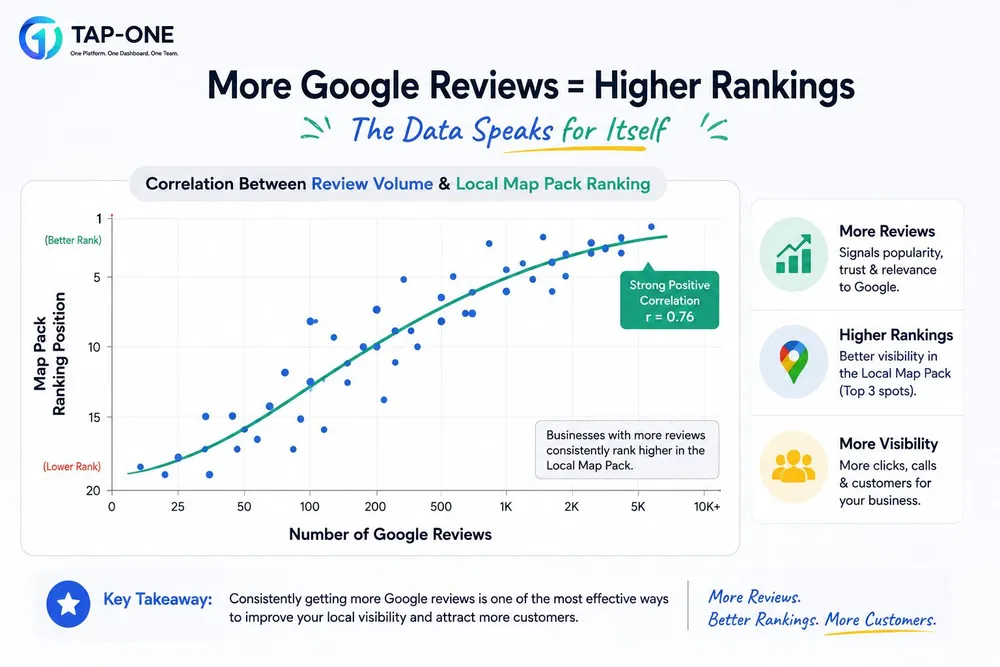
There's a specific pattern that shows up across almost every category I've audited: businesses ranking in the top three of the local map pack tend to add somewhere between four and twelve new reviews a month, consistently, not in a single burst.
A burst of forty reviews followed by nothing for three months reads differently to Google than a steady trickle. Recency carries weight on its own, separate from total count. A profile that stopped growing eighteen months ago, even with three hundred reviews sitting on it, starts losing ground to a newer competitor gaining five a week.
| Review Pattern | Typical Map Pack Outcome | What It Signals to Google |
|---|---|---|
| Steady 4–12 new reviews/month | Consistent top-3 presence | Active, trusted, ongoing customer satisfaction |
| One-time burst, then silence | Temporary bump, then decline | Looks manufactured or campaign-driven |
| High rating, very low volume | Rarely ranks above high-volume rivals | Not enough data for Google to trust the signal |
| Old reviews, nothing recent | Slow, quiet drop in visibility | Profile reads as inactive or possibly closed |
The Mistakes I See Most Often
I've gone through hundreds of these profiles by now, and the same handful of mistakes show up on repeat.
- Only asking customers who already seem happy, then quietly not asking the ones who don't. [[Google Search Central|searchCentral]] calls this gating, and it's a policy violation that can get a listing suspended if reported.
- One templated text message sent once, then calling that a review strategy for the year.
- Never replying to a single review, good or bad, which reads as neglect to a customer and probably to Google too.
- Treating reviews as a quarterly project instead of something that runs every single day in the background.
- Offering a discount or freebie in exchange for a review, which is against Google’s guidelines and can get reviews stripped in bulk once flagged.
- Asking too late, days after the visit, when the memory of the meal or service has already faded and the motivation to write something is gone.
QR, NFC, or a WhatsApp Message: Which One Actually Converts
There was a stretch where businesses handed out cards with a website printed on them and expected people to type it in later. Almost nobody did.
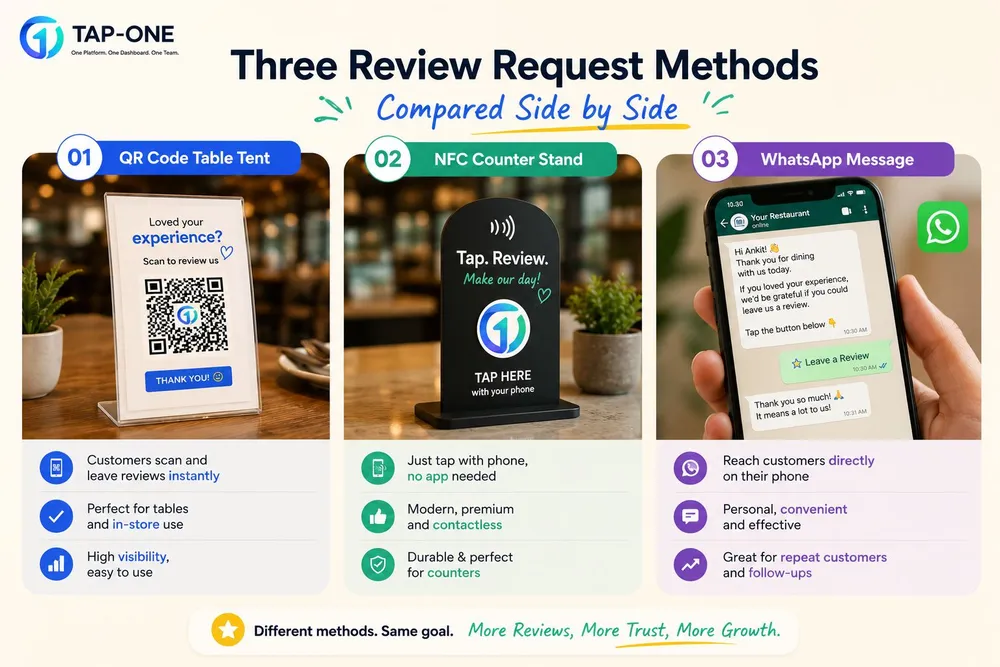
A QR code solves the friction problem cheaply. Any phone camera reads one now, so a sticker on the receipt or a small stand on the table gets you most of the way there.
NFC costs more per unit but skips the camera step entirely; a tap and the review page opens. It suits a counter display or a branded card handed over at checkout, somewhere the interaction already feels a bit more deliberate.
WhatsApp is the odd one out because it isn't tied to a physical object. Send a short message an hour or two after the visit with a direct link, and in India specifically the open rate beats SMS and email by a wide margin.
| Method | Cost to Set Up | Typical Conversion | Best Placement |
|---|---|---|---|
| QR code | Low, print and laminate | 15–30% | Table tent, receipt, door sticker |
| NFC tap card/stand | Moderate, one-time hardware cost | 25–45% | Billing counter, reception desk |
| WhatsApp follow-up | Low, message credits or automation tool | 20–35% | Sent 1–3 hours after the visit |
What This Looks Like for a Restaurant vs. a Clinic vs. a Salon
The mechanics stay the same across industries, but where you place the ask changes a lot.
- A restaurant gets the best results with a QR code at the table, timed to the bill, since that’s the moment satisfaction peaks and the phone is already out.
- A clinic does better with a WhatsApp follow-up sent a few hours after the appointment, since patients rarely want to pull out a phone while still at the reception desk.
- A salon or barbershop tends to convert well with an NFC tap right at the billing counter, since the customer is standing there anyway, waiting for change or a card machine.
- A gym or fitness studio often gets the strongest response from a monthly WhatsApp broadcast rather than a per-visit ask, since members visit too often for a per-visit prompt to make sense.
Deploying AI Review Requests to Save Actual Time
Nobody on a restaurant floor has time to text forty people a day asking nicely for a review. That's the actual bottleneck, not motivation.
The fix is triggering the request automatically off an event that already happens: a bill closing, a booking ending, a delivery marked complete. No one has to remember anything.
Some tools take it further and generate a message that references what the customer actually bought. A note that mentions the specific haircut or dish tends to get more responses than a blanket "thanks for visiting."
Building a Follow-Up Sequence That Doesn't Feel Like Nagging
One ask rarely gets you there. What works better is a short, finite sequence:
- The first prompt happens at the point of sale, QR or NFC, right when satisfaction is highest.
- A follow-up two or three hours later by WhatsApp or SMS for anyone who didn't act in the moment.
- One last nudge at the 48-hour mark, only if there's still been no response.
- Then you stop. Three touches is the ceiling. Past that you're just annoying people.
Responding to Reviews Is Part of the Strategy, Not an Afterthought
A reply does two jobs at once. It shows the reviewer their feedback landed somewhere, and it shows every future reader how the business handles both praise and complaints.
Mention the actual service in the reply. "Thanks for the review after your knee physiotherapy session" reads as more genuine, and reinforces relevance signals, better than a generic "thanks so much."
For a bad review, stay level, acknowledge the specific complaint without getting defensive, and move the details offline. Arguing publicly almost never helps, and future customers usually read the reply more carefully than the original review.
How Many Reviews Is Actually Enough
There's no fixed number, but a rough benchmark helps set expectations. Businesses competing seriously for a local map pack spot in a mid-sized Indian city usually need somewhere between 80 and 200 reviews to hold a top-three position against similar competitors, though this varies a lot by category and city density.
What matters more than the total is the trend line. A profile adding reviews every week outperforms a profile that hit 300 two years ago and stopped.
What Not to Do, Even If It Seems Harmless
- Don't buy reviews. Google's detection has gotten significantly better at spotting patterns from review farms, and the penalty is often a full suspension, not just removed reviews.
- Don't offer a discount, free item, or entry into a giveaway in exchange for a review. This is explicitly against Google's guidelines regardless of how it's worded.
- Don't filter who gets asked based on how happy they seemed. That's gating, and it's one of the more commonly reported violations.
- Don't ignore negative reviews hoping they'll get buried. They don't disappear, and an unanswered bad review sitting at the top of a profile does more damage than most owners realize.
A Real Example: What Changed for One Restaurant
A restaurant I worked with in Jaipur was averaging maybe six to eight new reviews a month before switching to an automated QR and WhatsApp system. Staff were asking inconsistently, mostly when they remembered, mostly with regulars they already knew were happy.
After setting up a QR code at every table plus a WhatsApp follow-up for anyone who didn't scan it, monthly review volume roughly tripled within the first two months. The map pack position moved from page two of local search results into the top three for their primary category within about ten weeks.
Nothing about the food or service changed. What changed was that every customer got asked, every time, instead of some customers getting asked sometimes.
Where This Fits Into a Bigger Local SEO Plan
Reviews alone won’t carry a listing indefinitely if the rest of the profile is neglected. This works best alongside a properly filled-out Google Business Profile, categories chosen correctly, photos kept current, and a website that backs up what the profile promises.